

Featured Review
28 Years Later: The Bone Temple ★★★★

Release: 14th January 2026
Director: Nia DaCosta
Starring: Ralph Fiennes, Jack O’Connell, Alfie Williams, Emma Laird, Erin Kellyman, Maura Bird & Chi-Lewis Parry
As a generational talent, Nia DaCosta’s record speaks for itself: Little Woods, Candyman, the unfairly maligned The Marvels, and London Film Festival favourite Hedda stand shoulder-to-shoulder as an impeccable run of form. There’s a growing confidence and assurance when witnessing her mixing genres and styles, or in the case of Hedda, one iconic dolly shot that speaks volumes about Tessa Thompson’s titular character. When given the right time and conditions, we witness a director at her most liberated, and in 28 Years Later: The Bone Temple, it is her best work yet.
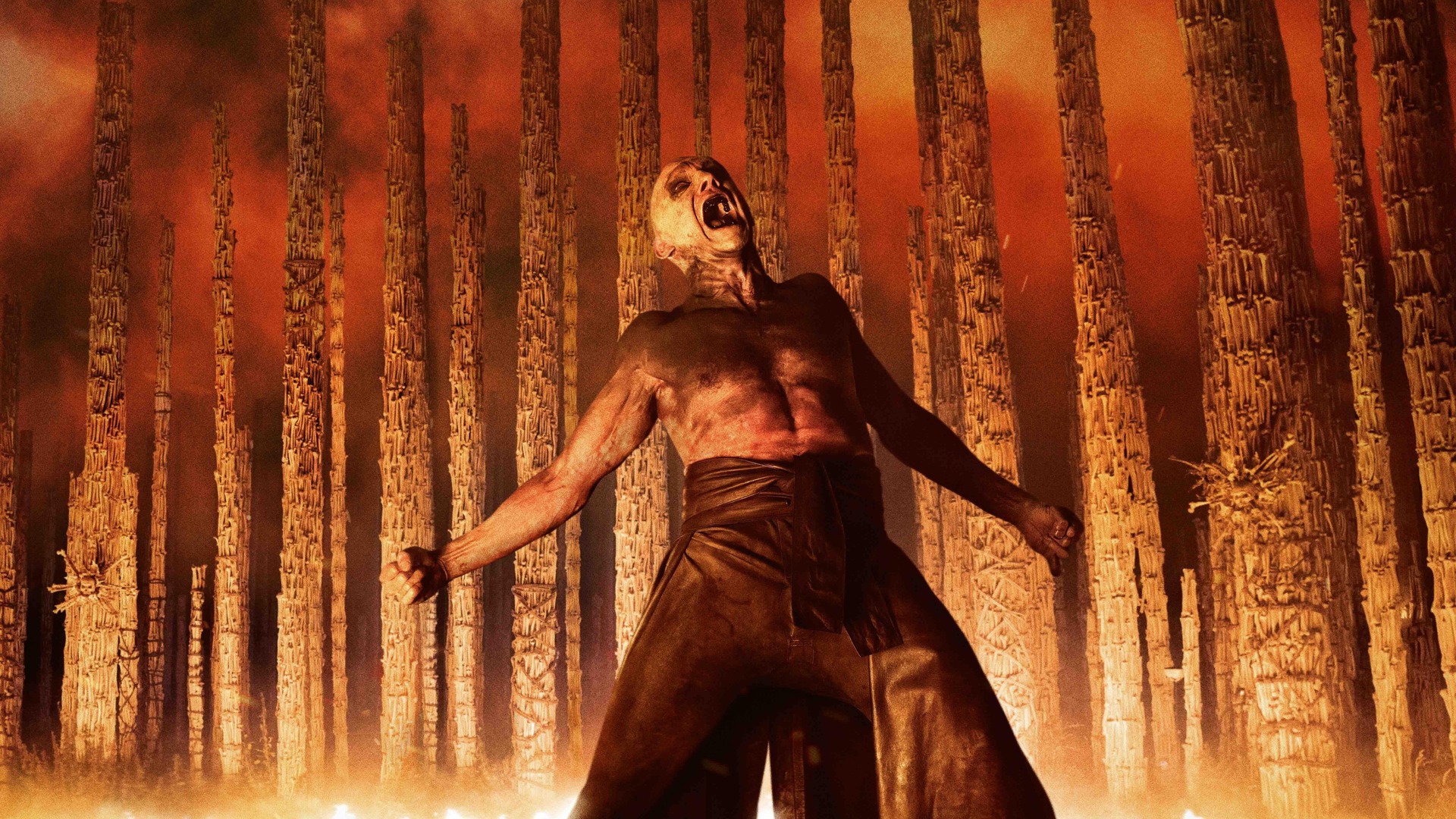
In the sequel to Danny Boyle’s 2025 film, she directs a scene which can only be summarised as metal. Dr Kelson (a brilliant performance by Ralph Fiennes) puts on a showstopping performance filled with fire and over-the-top theatricality as he dances around his memorial for the dead to the blasting sounds of Iron Maiden’s Number of the Beast. It’s all part of the act, a ruse staged for Sir Jimmy Crystal (Jack O’Connell in fine villainous form). Crystal brings along his band of followers – The Fingers – to meet “St Nick” aka Satan. Kelson, who doesn’t want to be Crystal’s next victim in his violent sprees, reluctantly engages in the charade to put on a performance that would give Sir Jimmy credence for his demonic preaching philosophies. The moment – where Fiennes is clearly having the time of his life – is delivered with so much visual pomp and swagger, it would render any audience into spontaneous applause. For that reason alone, alongside the film’s wild, twisty, and brutal turns, The Bone Temple delivers as one of the franchise’s best.
You can tell DaCosta was enjoying herself. That same filmmaking freedom where boundaries of the medium are pushed can be said for writer Alex Garland. His post-Brexit/COVID themes for 28 Years Later became the anchor for Boyle’s film – a ‘Little Britain’ ideology closed off from other countries, leaving surviving communities with their nostalgia of the past free to invent new mythological stories and hero-worshipping to suit their isolated worldview. And instead of scares (which there are plenty of), it’s an introspective examination on how we retain our humanity during dark times and a profound entry in the series.
It’s clear how much Garland and Boyle were touched by the events of the pandemic, knowing how ‘close to home’ London’s empty streets echoed that reality of 28 Days Later. The real-life events that proceeded out of it, such as the Orwellian political jingoism, the rise of the far-right, and the rejection of truth and values for self-interested individualism, presented a world far more terrifying than the plague itself, and ripe for film adaptation. There’s bravery in that exploration, rejecting the safe route of homogenised IP storytelling for a challenging recontextualisation of the franchise that adds plenty of ‘meat on the bones’ for what it means for today’s society and culture. And its foresight to film the new entries back-to-back provides the fertile groundwork for DaCosta to pick up from where Boyle and Garland left off and drive those feelings home.
The Bone Temple asks a simple question: when the world has been devastated by widespread violence and death, what takes its place in the vacuum? What happens to the soul of a nation when order and civility are erased from memory for new ideologies to become the norm?
Enter Sir Jimmy, sitting on his makeshift throne. The iconography DaCosta creates is deliberate: a self-appointed king worshipping his childhood “hero” Jimmy Savile without the benefit or luxury of learning about his idol’s monstrous crimes. Blissfully basking in the aura to “fix” the new world, he speaks to his master, his father, taken from him during the outbreak (the opening prologue of 28 Years Later). After receiving his “orders”, a frightened Spike (Alfie Williams) begins a barbaric initiation: a knife fight with Jimmy Jimmy (Robert Rhodes). Survive, and he will be forced to join their clan. If not, then death will be his only escape.
That coming-of-age essence intensifies under DaCosta’s direction, tapping into a Lord of the Flies-esque drama of children and young adults losing their innocence for the collective cause of violence and chaos. It’s a frightening exploration of how fear intimidates and controls, and through Spike’s eyes, we witness the rapid escalation of the Jimmys in spreading their fear onto others, culminating in a shocking scene involving skinning people alive in a neighbouring community.
It’s not the only thing that underpins The Bone Temple. Faith plays a big part in DaCosta’s film, a nation of God’s children abandoned to fend for itself with all the visual bluntness of a ‘hell on Earth’. Garland’s cautionary tale evokes a nation seeking relief and salvation (like the NHS as one joke typifies), but highlights the dangers of looking in the wrong places for those answers, particularly by those ‘charismatic leaders’ who are happy to incite others but never get their hands dirty (or certainly deny their involvement for other web-spun lies). With the Jimmys as a prime example, the rise of populism gives way to extremism, where human sacrifices are an act of “charity” for St. Nick. DaCosta’s direction never shirks, flinches, or pulls away in its engagement. The gruesome horrors are laid bare through her cinematic lens, leaving space for O’Connell to deliver his best work that’s up there with Remmick from Sinners.
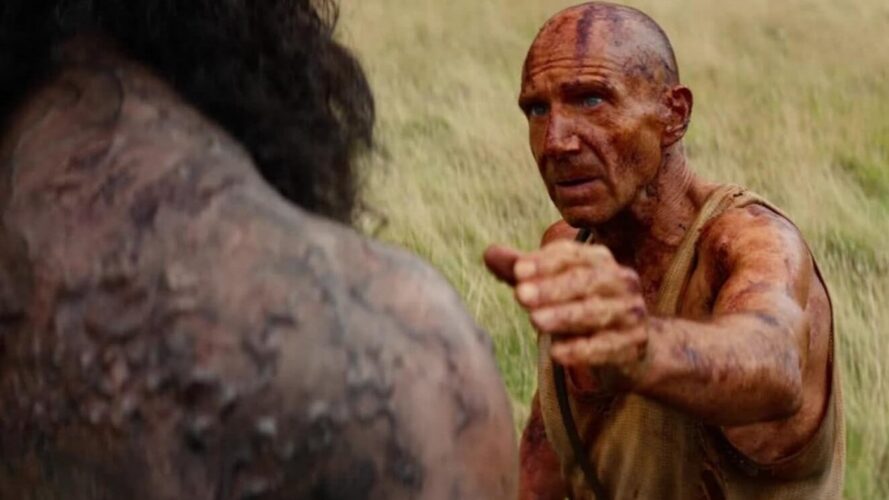
However batshit and unconventional The Bone Temple is, its impressive counterbalance comes through Dr Kelson. Fiennes’ performance cannot go unmentioned, whose unwavering compassion and empathy provide a soulful balm to the film’s hellish undertones. His ownership of the role is a joy, capturing a life he fights so hard to preserve, and helps chart The Bone Temple’s affecting new direction.
It’s channelled through his frequent encounters with Chi-Lewis Parry’s Samson, a physical, brutal presence with a death kill ratio to rival any character in Mortal Kombat. He subdues Samson using morphine darts, allowing him access to his behaviour and consciousness. For the first time, we see the infected through their eyes, a world before they turned, offering the possibility of returning to what they once were.
Not only does this present a fresh angle in an oversaturated genre, but Garland’s script naturally allows for Anglophile humour to take hold before converging into an explosive ending. The surrealness of Kelson dancing with Samson to Duran Duran’s Ordinary World are some of the laugh out moments it entails. But amidst that, there is a genuine and sincere catharsis at play, a film seeking hope as another path towards salvation.
It coincides with DaCosta’s ability to stamp her own authority. Re-teaming with her long-time cinematographer Sean Bobbit, it pays homage to what we’ve seen before but is unafraid of innovation. The camera, for instance, is placed right in the infected eyeline. With the rage up close and personal, tension and terror remain high throughout. Editing and pacing are brisk, and solemn moments find their peak – all of which DaCosta maximises to full effect.
The Bone Temple kickstarts 2026 in a special way – a chilling and intensely satisfying sequel. DaCosta, Garland and Boyle make for an outstanding combo that bravely charts the franchise into a bold new direction. With a few surprises up its sleeve, part three in this daring trilogy can’t come soon enough.







-

 Features4 weeks ago
Why are Casino Games a Popular Theme in Movies?
-

 Featured Review6 days ago
Hamnet ★★
-
 News1 week ago
Full UK Line-Up Announced For 2026 Japan Foundation Touring Film Programme
-
 Featured Review2 weeks ago
Team MM’s Favourite Films Of 2025
-

 Movie Reviews2 days ago
People We Meet On Vacation ★★★
-

 Movie Reviews1 week ago
The Spongebob Movie: Search For Squarepants ★★
-

 Movie Reviews3 days ago
Marty Supreme ★★★★
-

 Movie Reviews6 days ago
The Housemaid ★★★