


Features
Exit 8 & Backrooms: The Horror Of The Mundane

As Nine Inch Nails once said “I believe I can see the future / Cause I repeat the same routine”.
To most people, it seems that the idea of the mundane might be scarier than any existential threat. If horror cinema is at it’s best when it takes something relatable or recognisable and turns it into something terrifying, then it seems only natural that things we encounter near daily would be the source of terror.
After all, for some there are few things more dread inducing than a commute. This can be for a myriad of reasons – the job is unfulfilling, colleagues aren’t pleasant, the pay is awful – but for some it’s the routine of commuting that fills them with a sense of deep horror. How many people spend day after day getting on the underground tube system, or a train or a bus, the same ones at the same time, going to the same stops often with the same people. Some call it routine, but for others it’s a monotonous rite of passage. How many commutes are memorable? How many do we actually recall at the end of the year?
That is what makes the horror of Exit 8 quite so frightening. Yes, it takes its cue from a video game, and yes there are surreal moments that the Japanese horror throws at the audience, but the real gem of horror comes from the same thing we can all relate to. After all, anyone who has tried to navigate the labyrinth of the London Underground system will know, it’s very easy to get lost. Endless tunnels that all look the same, all advertising the same West End shows, the same payday loans, the same forthcoming movies. We all glimpse a moment in the life of someone, a man on his phone, a woman looking through her bag, a child crying.
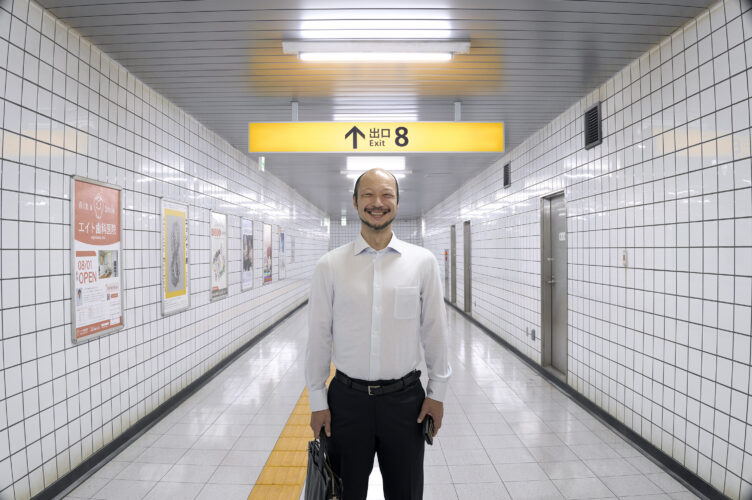
Exit 8 uses the subway system – something as common as anything – and turns it into a universal terror. How many of us have lost ourselves in thought while traversing the transit system? One of the many underground tunnels that perpetuate the world? What the film does its turn a walk to an exit into a descent into guilt and terror. After all, the further you go, the darker it gets. You can only salvage yourself if you really go deep.
You see it’s the universality of a situation that really speaks to people on a gut level. Not everyone is scared of clowns, not everyone dreams, but everyone has to travel. Everyone has to get to work, or to school or to somewhere. Everyone can relate to that feeling of being lost. It’s the most primal feeling – being lost. We experience it as children, the terror of not seeing where your parent are for even a second and suddenly you’re alone in the world, and it’s a terror that the human psyche clings to for safety.
It’s why films about space can be so scary, in space you are truly, and utterly alone. But we all experience these feelings of being lost and alone.That things are safer when you’re with people. Exit 8 knows this terror all too well, but so does Backrooms. In fact Backrooms takes it a step further. There is a classic fear to being underground, it’s one step closer to being buried alive, claustrophobia is common in people. But to be afraid of being in an empty room – now that is something worth examining. Backrooms has its origins in a web series, which itself is taken from a Creepypasta – an online urban legend. The titular backrooms might be a strange liminal space between realities that trap you, but their facade – an empty, rather plain room – is the real terror. Much like Exit 8 the terror of Backrooms is the taking of a common, unthreatening thing and turning it into a prison, a maze that there is no escape from. Both films present something we can all relate to and make us wonder what we would do if we were unable to escape it. What that lost feeling would do to us.

After all the only difference between an empty room and any other is objects, the accumulation of furniture and material possessions but once you remove it, it becomes a foreign space. Once you remove people from spaces, it becomes more threatening. And while both films do have a supernatural element to their horror, the real fear that they create is by something altogether more common and therefore more disturbing.
The films pose a very simple question – why? Why is a subway so scary? Why is an empty room so scary? The answer – because they shouldn’t be. There is nothing inherently scary about a room without anything in it, or a long winding inner city transit system without people. Neither are actually that dangerous in and of themselves but what they represent is. Pointlessness. We are ultimately scared that our journeys are leading us somewhere we don’t want to be, that our jobs or our careers are unfulfilling, that the accumulation of material wealth is not satisfying.
The plot machinations of either film are neither here nor there, their real bone chilling terror at their core is a simple one – each commute we take, each room we fill, brings us a day closer to our death and do we really have much to show for it? Are we really satisfied? Are we happy? Or are we trapped in endless tunnels, entering endless rooms waiting for the inevitable?
Or… as Nine Inch Nails said “Every day is exactly the same”.


-

 News3 weeks ago
Earliest Autograph Of Arnold Schwarzenegger Goes On Sale To Support UK’s Smallest Cinema
-

 Featured Review5 days ago
Pinocchio Unstrung ★★★
-

 Movie Reviews3 weeks ago
Gail Daughtry And The Celebrity Sex Pass ★★★
-

 Featured Review2 weeks ago
Evil Dead Burn ★★★
-

 News4 weeks ago
Oscar Winner Rachel Shenton Chooses Best Short Film As The Midlands Movies Awards Announces 2026 Winners
-

 Featured Review4 weeks ago
The Last Viking ★★★★
-

 Featured Review3 weeks ago
Minions And Monsters ★★★
-

 Features3 weeks ago
MM Shorts – Between Breath And Silence