


Featured Review
Exit 8 ★★★★

Release: 24th April 2026
Director: Genki Kawamura
Starring: Kazunari Ninomiya, Yamato Kôchi, Naru Asanuma & Nana Komatsu
From the very first note of Maurice Ravel’s Bolero, that famous song that ice skaters Jayne Torville and Christopher Dean performed to at the 1984 Winter Olympics, Genki Kawamura’s Exit 8 sets its stall pretty high. Our asthmatic hero, simply named ‘The Lost Man’ (Kazunari Ninomiya), finds himself lost (pun intended) in his own world on a packed commuter train in Tokyo, Japan. The music blasts from his AirPods. He doomscrolls to his heart’s content. Not even an angry man who bizarrely (and rudely) shouts at a mother and her crying baby shakes him out of resolve. For The Lost Man, he has other things on his mind as he rushes to get to his new temp job, until a phone call from his ex-girlfriend forces him to reconcile his reality. She is pregnant.
There’s an impressive seamlessness to this introduction that Kawamura deploys, consisting of first-person camera trickery and long one-takes as our protagonist is distracted by the news while searching for the exit. And before you know it, the audible hustle and bustle of commuting is drowned out, the familiar white and yellow tiles of Kotake Create’s original video game start to seep in, and suddenly our player is trapped in a never-ending, purgatory loop.
Like the game itself, Kawamura and co-writer Kentaro Hirase keep things simple. There’s no fancy explanations or backstory for its genesis, existing like its own unsolved X-Files mystery with a Squid Game-level of mental endurance and perception to spot the anomalies to escape it. Players have to abide by the game’s rules: Turn back if you spot something unusual. Move forward if you don’t. Find Exit 8. Any failures, and the level counter is reset back to zero. And that’s the gist of the story and the beauty of it all. In an age where recent video game adaptations can be somewhat ropey, lost in the sauce of fan nostalgia and corporate wishlists, Exit 8 manages to defy those odds, and crucially, makes you want to play the game just to experience the twisted psychological adventure for yourself.

Faithfully recreating the endless, walking corridor from the game is a major, technical highlight of Kawamura’s film. As The Lost Man navigates the looping labyrinth, you’re trying to work out where the production sets start and end, where the visual effects add definition and where the careful edits keep its unsettling nature going. Thanks to art directors Ryota Kobayashi and Ryo Sugimoto, set designer Yutaka Motegi, visual effects producer Jinhee Kim, and editor Sakura Seya, the resulting harmony is a pure piece of cinema magic.
Kawamura and Hirase certainly make use of this design when it comes to imposing their narrative choices. They split the story into three distinct chapters, taking on the POV of The Lost Man, Yamato Kôchi’s The Walking Man (a non-playable character in the game, but given a fun origin story) and The Boy (Naru Asanum). It’s a risk, nevertheless, given the game’s basic structure and non-existent backstory to make a direct, shot-for-shot adaptation. In the game, players would naturally go head-on into the chaos. Here, the controller is put to one side, where the duo craft both a curious yet compelling story, and it mostly works. Because once the camera shifts from first person to third person, Kawamura is granted more creative licence to operate.
The story of The Lost Man leans into this notion as 8’s focal point. Without divulging into spoilers, his early frustrations to beat the game are met with the character making notable mistakes or the game punishing him for thinking you can outsmart it (such as taking photos to memorise the environment). The motions are unrelenting as the film slowly and cleverly builds geography and rules within each loop, only deepening the crisis he faces and amplifies his yearning to escape.
Admittedly, watching characters spot the anomalies is simultaneously well-devised yet equally frustrating! As the audience, we’re already ‘clued up’ on its looping ‘spot the difference’ mechanics. Kawamura encourages audiences to play along, and some moments are deliberately prolonged and exaggerated when each anomaly takes on a twisty turn. But even with its repetitive format, there’s a mutual understanding, a golden handshake if you will, of the logic that games can exist with a deeper meaning. No matter how straightforward the premise is, they can exist to expand on what audiences may already know whilst positioning Exit 8 on its own terms. After all, the video game industry is a multi-billion-dollar enterprise, with developers utilising the latest technology to create immersive movie-like experiences. 8 is just another type of immersion; one for how its characters mentally interpret the game – and that’s where the real fun begins.
It’s not lost in the conversation when isolation amidst routine dominates 8’s paradigm, the feeling where disconnection and distraction form as an internal escape. The film deliberately taps into an individualistic mindset, observing self-contained routines (such as a daily commute), a lack of decision-making (such as Lost’s watching an angry man getting upset at a mother and her baby) or other crazy stuff that are somewhat normalised without a societal reaction. Yet under game rules, the purgatory existence is treated as a magnification of their own parental fears, be it Lost’s inability to make a decision about his baby, or The Walking Man’s own fate. While lost in the repetition, it’s entertaining seeing whether they learn from their past mistakes or continually be the same person that got themselves trapped in the game in the first place.
It’s a complex beast Kawamura tries to tackle, and by the third act, the sentiment doesn’t always come together as fluidly as one would imagine. The creep factor loses momentum and could have been dialled up a notch to keep audiences in that perpetual state of fear. The repetitiveness can feel stretched in its 95-minute runtime, especially in its points of exaggeration. Not every element from the game gets adapted, and the looseness of the story may raise further questions about what we’re witnessing of its characters in tying up those emotional arcs.
Yet, even with its flaws, it’s still a miracle for what it accomplishes. At least it takes a risk, happily breaking the routine of other video game adaptations out there in the market. At least it challenges and puts forward the argument of how inward fears end up magnifying into something unavoidable. At least, Kawamura attempts some ‘meat on the bones’ metaphors and symbolism to give audiences weight and depth to care about. It’s a satisfying cinematic experience, and in showcasing the power of liminal spaces, we’re treated to a faithful and atmospheric adaptation that dares to be different.








-

 Featured Review4 days ago
Digger ★★
-

 News4 days ago
Shane Meadows Headlines + Joe Lycett Named First Patron As 2026 Forward Film + TV Festival Opens In Birmingham
-

 Featured Review4 weeks ago
Venice Film Festival 2026 – Primetime ★★★★
-

 News1 week ago
70th BFI London Film Festival Announces ‘LFF For Free’ Programme
-
 Featured Review2 weeks ago
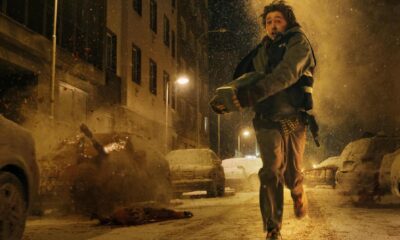
Resident Evil ★★★★
-

 Featured Review4 weeks ago
Venice Film Festival 2026 – Wild Horse Nine ★★★★
-

 Featured Review2 weeks ago
Sense And Sensibility ★★★★
-

 Featured Review3 weeks ago
Oasis: Don’t Look Back In Anger ★★★★