
Featured Review
Her Private Hell ★★★

Released: 25 September 2026
Director: Nicolas Winding Refn
Starring: Sophie Thatcher, Havana Rose Liu, Charles Melton
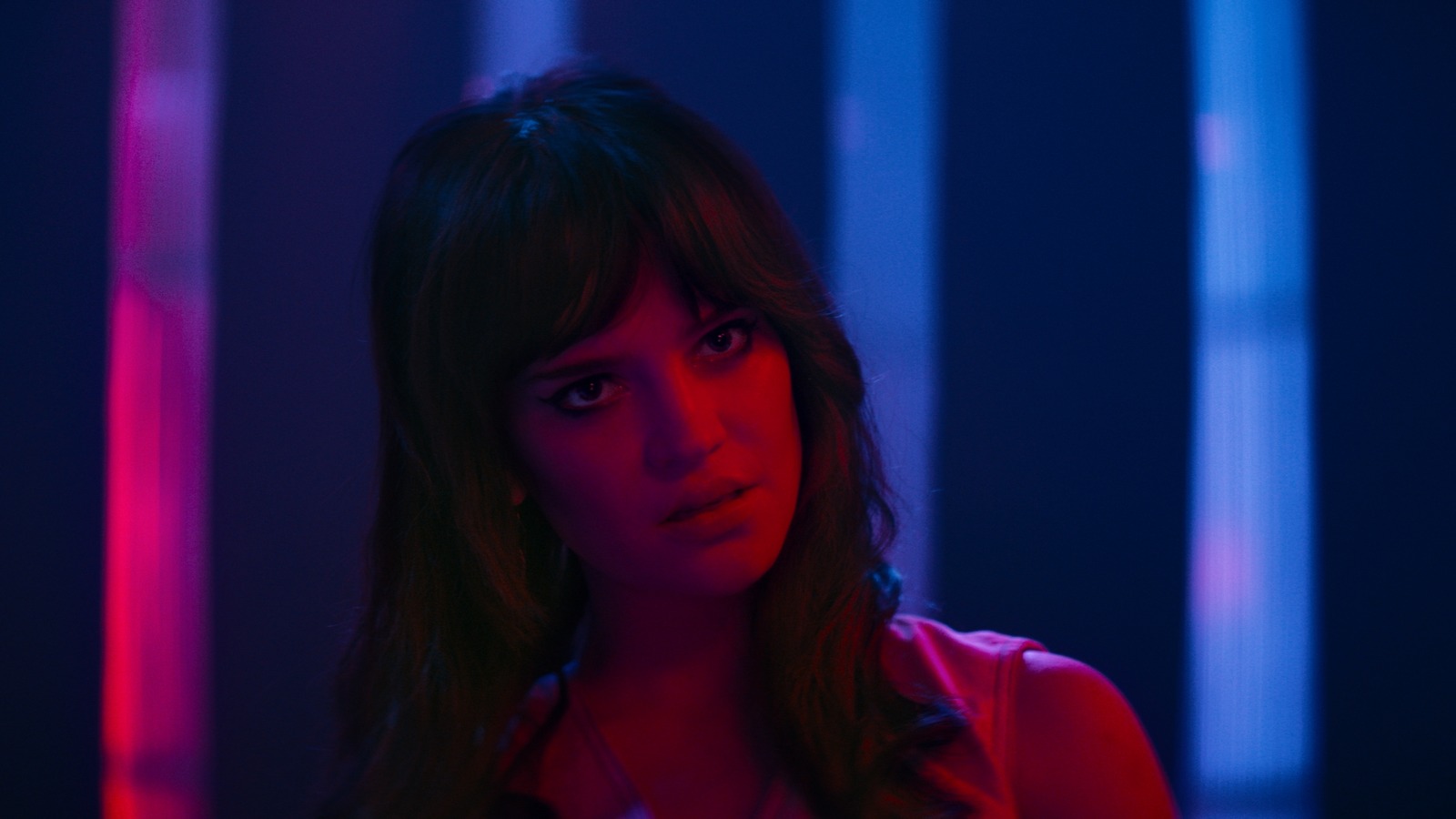
Nicolas Winding Refn hadn’t made a feature in over a decade, and few expected him to make another after the cardiac arrest that nearly killed him in 2019, an experience he’s described as being given a second chance by God. Her Private Hell, which premiered out of competition at Cannes, is the first real evidence of what he’s done with it: he’s called it a fairy tale about a young girl searching for her father, only to create the perfect father and become trapped in her own nightmare of his making. After years of finding Refn’s devotion to style increasingly exhausting (particularly in Only God Forgives), I was surprised by how invested I became in what was underneath it. Her Private Hell still looks like a film only Nicolas Winding Refn could make, but for once, the beauty actually has something to say.
The film opens on a colossal figure made entirely from shards of glass, towering over a futuristic city as two enormous hands reach into the void, straining for something just out of reach. It’s an almost absurd Refn image, beautiful and completely artificial, but it establishes the film’s central obsession immediately: fathers and daughters trying to find one another through the fractured glass. At the centre of the fairytale is Elle, a young actress returning to the family hotel where her filmmaker father is shooting his latest project. Played with a tired cynicism by Sophie Thatcher, she finds Jonny Thunders (Dougray Scott), with whom she has a strained relationship, staging Candy Floss. The sci-fi comic adaptation feels less like cinema and more like Galaxy Quest (1999) or a high-concept fashion shoot, its actresses poured into skin-tight costumes and directed to move suggestively while under alien threat. Jonny surrounds himself with women, including Elle’s former best friend turned stepmother, Dominique (Havana Rose Liu), and an eager newcomer named Hunter (Kristine Froseth), each trapped in his self-absorbed orbit.
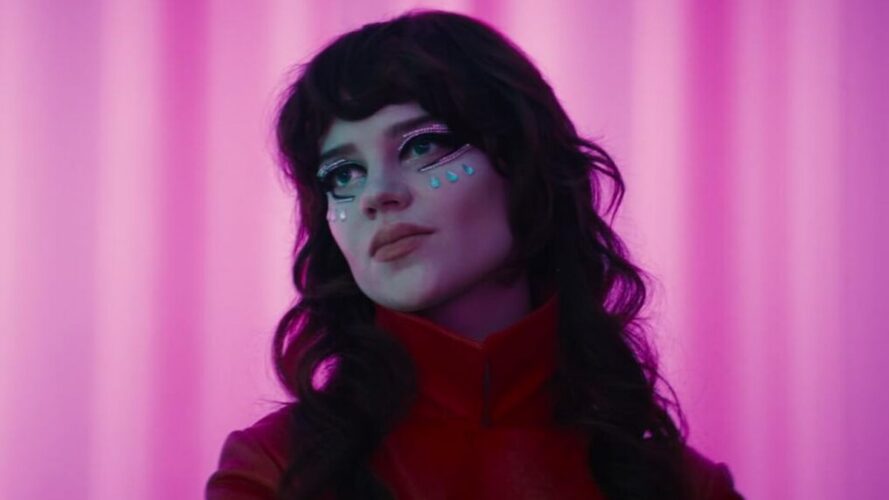
When Elle lays out her father’s influence to Hunter, Refn hard-cuts to Jonny shirtless at the bathroom mirror, shaving. It’s a beautifully obnoxious piece of visual commentary that reduces paternal dominance to mere vanity. That impulse runs through the entire setting: stylists prick actors with needles for good luck, treating pain as a necessary cost of aesthetics. Refn has always relied on visuals to carry his arguments, but here the surface itself becomes the critique. Everything is pristine, yet nothing feels alive. Blue neon bleeds over the city skyline, obscuring the windows until the world outside looks entirely empty. The characters fade into commodities, leaving the men behind the camera to dictate what remains. Even outside Jonny’s film, they seem unable to escape the male gaze.
Then there’s “Leather Man”, because apparently the film wasn’t already Refn enough. Private K (Charles Melton), an American soldier wandering postwar Japan, searches for his missing daughter while hunting the grotesque figure responsible for a series of grisly murders. His victims are smashed against glass before silver, spiked hands drive into their bodies. Melton drifts through it with an almost comical nonchalance, trading his military uniform for a leather jacket that is pure Refn fantasy. For anyone who, like me, was astounded by him in May December (2023), there isn’t quite as much to sink your teeth into here; the role asks for more presence than performance. But Private K’s journey contains the film’s most interesting idea. His missing daughter turns out to be reading the same comic Elle and Jonny are adapting, collapsing the line between fiction and reality. To find her, Private K has to confront Leather Man, and in doing so become something of a ghost himself. What initially looks like another exercise in masculine violence becomes something stranger: Refn suggesting that protecting a daughter might require destroying the violent, possessive version of masculinity built around the desire to protect her in the first place. It’s a surprisingly interesting idea for a filmmaker whose work has so often been fascinated by men who turn violence into identity, even if Melton’s deliberately vacant performance leaves little room to explore it beyond the concept itself.
For all its mist and increasingly tangled mythology, Her Private Hell eventually reveals a surprisingly direct emotional core. Fathers searching for daughters. Women trying to escape identities imposed upon them. Thatcher and Liu are particularly effective as former best friends turned stepmother and stepdaughter, with Refn gradually revealing just how close they once were. When Dominique tries to reconnect, the two fall back into a secret language of wolf-like barking, a reminder of the friendship that existed before Jonny pursued Elle’s best friend and made her part of the family. Later, Dominique admits that being best friends again is probably out of reach, but promises she’ll always be Elle’s “evil stepmother”. Elle replies that the family is rotten, and they laugh. It’s one of the film’s sweetest exchanges, made more affecting by everything that has happened between them. Refn’s beauty gradually becomes suffocating rather than merely decorative: immaculate surfaces and artificial landscapes turn the act of looking into another form of control, as though his characters can never escape the roles imposed upon them.
By the closing stretch, the film’s cool detachment finally gives way to a frenzied, almost Shakespearean reckoning, as Elle’s pursuit of closure with Dominique curdles into something close to madness. It’s an oddly thrilling turn, and I found myself completely hooked. Usually, by this point, I’ve checked out of the self-indulgent masquerade of beautiful images demanding to be admired. Here, though, those images finally become part of the horror, making the film’s obsession with beauty and performance feel increasingly sinister. After years of Refn films leaving me admiring the surface while feeling increasingly detached from everything underneath it, Her Private Hell was the first time in a long time that I actually wanted to stay inside the nightmare.









-

 News4 weeks ago
Full 2026 Programme Announced For BFI London Film Festival
-

 Featured Review3 weeks ago
Venice Film Festival 2026 – Primetime ★★★★
-

 News3 days ago
70th BFI London Film Festival Announces ‘LFF For Free’ Programme
-

 Featured Review4 weeks ago
The Incomer ★★★★
-

 Featured Review4 weeks ago
Late Fame ★★★★
-

 News3 weeks ago
Full Programme Announced For 20th Anniversary Edition Of Iris Prize
-

 Featured Review4 weeks ago
I Want Your Sex ★★★★★
-

 Featured Review3 weeks ago
Venice Film Festival 2026 – Bucking Fastard ★★★