
Featured Review
London Film Festival 2025 – Hedda ★★★★

Released: 29th October 2025 (Amazon Prime)
Director: Nia DaCosta
Starring: Tessa Thompson, Nina Hoss, Imogen Poots, Nicholas Pinnock, Tom Bateman, Finbar Lynch, Mirren Mack, Jamael Westman, Saffron Hocking & Kathryn Hunter
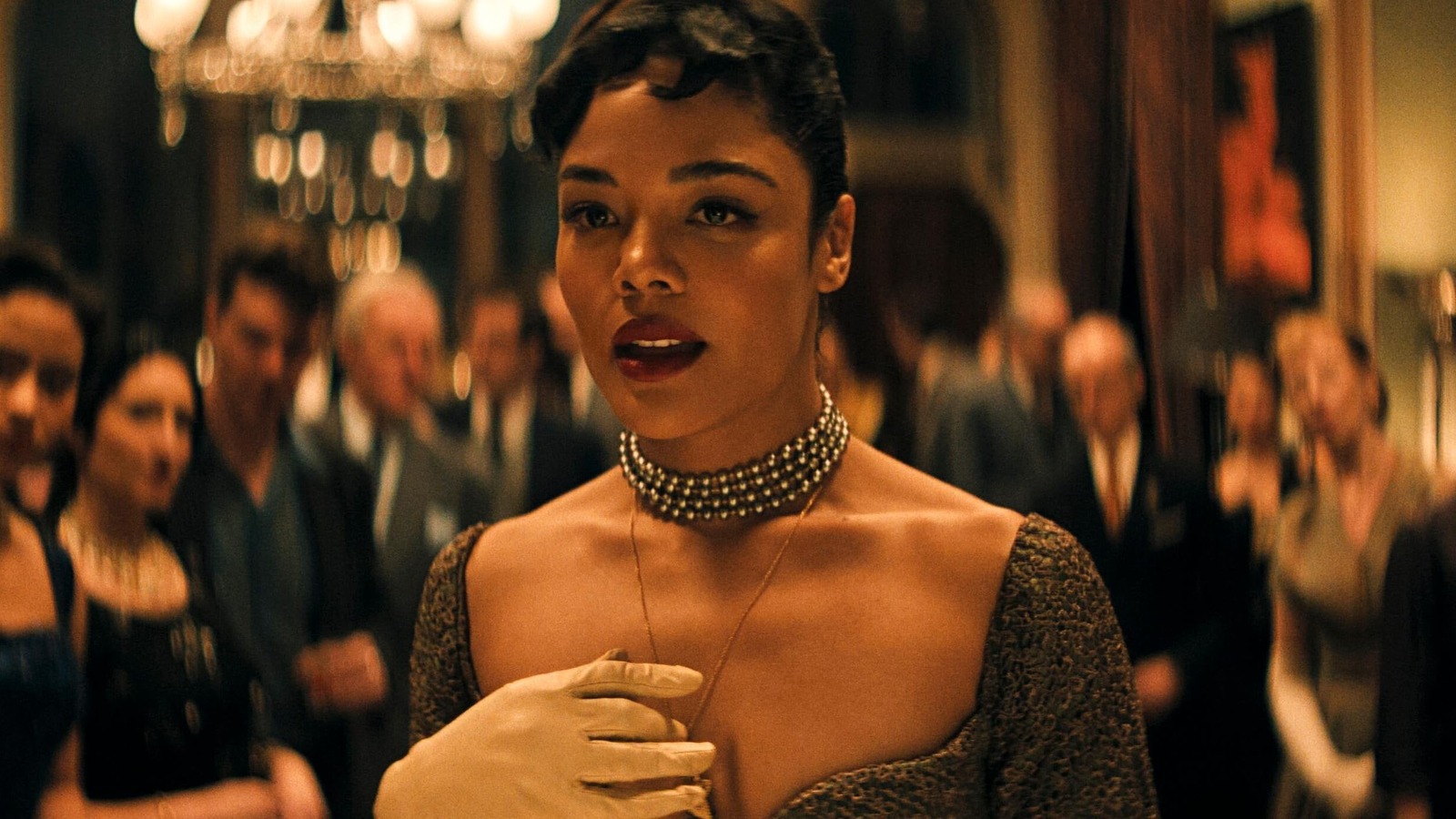
There’s one shot in Nia DaCosta’s Hedda which is simply divine. It revolves around Tessa Thompson’s Hedda Tesman (née Gabler). To the swing tune of “Oh So Quiet”, she revolves around the room as the centre of attention, a newly-wed socialite bored of her current circumstances, and therefore on her path to riches, she relishes influencing others to her whim. As she dances, her movement is propulsive, swaying to the rhythm of her own world until the music fades. She soon makes eye contact with one Eileen Lovborg (Nina Hoss) as she enters the room, and like a magnet drawn to their polar opposite, she gravitates towards her object of desire, realised through a slow-motion dolly shot towards an inescapable meet with her former lover.
There will be inevitable comparisons with director Spike Lee over that iconic shot, but you can immediately tell DaCosta was having fun, liberated from the toxic shackles of the Marvel Cinematic Universe. It’s very easy to ‘join the bandwagon’ as many people did at The Marvels release and celebrate its downfall despite many elements going against the film, the cast and the director herself, reaching as far as one major outlet that added fuel to the fire. Hedda – on the other hand – was an opportunity to reclaim something that was lost during her time within the corporate machine – autonomy and ownership. In her 1950s reimagining of Henrik Ibsen’s play, she crafts a racy, electric and extravagant examination of power structures, gender politics and standards, taking no prisoners while doing so. And in turn, DaCosta proves what she has always been – an exciting director in her element.
Stage-to-screen adaptations often come with the unfair criticisms of being “stagey” but DaCosta quells those arguments right from the opening scene. There’s a lovely sense of geography that DaCosta presents whenever Hedda moves around the mansion that her husband George Tesman (Tom Bateman) bought for her based on her impulsive whims. She knows the world revolves around her free-spirited yet commanding bohemian attitude, playing games with whoever is in her orbit, and the camera almost dances to her tune as she moves from room to room telling servants to remove flowers from her sight as they get ready for the lavish party she is about to host. “Nothing can go wrong, Hedda”, George pleads to his wife, knowing the evening’s events have the propensity to change their fortunes forever – a new job as a professor, climbing the social ladder and rescuing the couple from crippling debt. Unbeknownst to him is the ticking time bomb that is steadily in motion, thanks to Hedda’s scheming.

Within its 5-act structure, DaCosta (who also adapted and wrote the screenplay) stages the film like a traditional murder mystery where audiences already know who the culprit is. DaCosta fires that ‘Chekhov Gun’ of twists, turns and revelations and introduces her key players as her persons of interest – her dutiful husband who she unhappily contends with; Judge Roland Brack (Nicholas Pinnock), who is the epitome of patriarchal entitlement; and Imogen Poots’ Thea Clifton, who completes this star-studdied lesbian love triangle as partner to Eileen. Hildur Guðnadóttir’s score accentuates this atmosphere, mixing part swing music, a never-ending ticking clock and a sound that can only be described as breathless chants whenever there is a new revelation for Hedda to work through. Sean Bobbit’s cinematography also delights as the evening descends into a hedonistic-fueled madness and scandal filled with warm earthly tones.
The beauty is watching Hedda play subsequent mind games between these characters, creating more messy drama encounters than an episode of Eastenders. As an illegitimate child of a general aiming to ‘have her cake and eat it too’, the emphasis is on control. Conversations are deliberately bitchy, revelling in the spiralling chaos of others such as toying with her husband, fending off attraction and intimidation from Brack, and putting a wedge between Eileen and Thea’s relationship in the hope of rekindling her love for the former. It comes to a head when she discovers that Eileen is also after the same teaching position that George is seeking, having written her life’s work into a manuscript (along with the help of Thea) and is using that as entry into the patriarchal elite.
While more depth could have been pushed in this particular subject area, DaCosta doesn’t shy away from the social standings of the era. In this reimagining, Hedda’s Blackness is racially referred to as “duskier” while its notable queer-led storyline to which Hedda hinges itself upon, is looked upon as a societal taboo that draws curiosity from privileged men but never the acceptance. Making the switch from 1800s Norway to 1950s England only brings these points closer to home, showcasing how far these attitudes haven’t changed once placed through a contemporary lens, and how modern society has clamoured to maintain its existence.
Yet, it’s fun watching Thompson turn on the darkly comedic screws in her mind. The sheer magnetism of her performance is the constant switch between vulnerability and manipulation, working out the inner machinations to maintain her power and how far she is willing to exercise it. It’s a complex role that works hand-in-hand with Hoss’ Eileen, who tries to avoid scandal and further reputational damage for a fresh new start.
Hedda is a debaucherous riot, showcasing the best of Nia DaCosta and Tessa Thompson’s creative partnership. Up there with Ryan Coogler and Michael B. Jordan, the two cinematic Queens need to continue making movies together, because whenever they collaborate, magic always follows.








-

 Featured Review4 weeks ago
The Running Man ★★★
-

 Movie Reviews3 days ago
Dracula: A Love Tale ★★★
-

 Featured Review3 weeks ago
Wicked: For Good ★★★★
-

 Featured Review3 weeks ago
Nuremberg ★★★★
-

 News1 week ago
Iris Prize Reveals Final 2025 Awards Winners In ‘Closing Credits’ Ceremony
-

 Features4 weeks ago
5 Movies That Defined How We See Gambling
-

 News3 weeks ago
Glasgow Film Festival Reveals First Titles For 2026 Edition
-

 Featured Review3 weeks ago
Keeper ★★★