
Featured Review
Resident Evil ★★★★

Release: 18 September 2026
Director: Zach Cregger
Starring: Austin Abrams, Paul Walter Hauser, Zach Cherry & Kali Reis
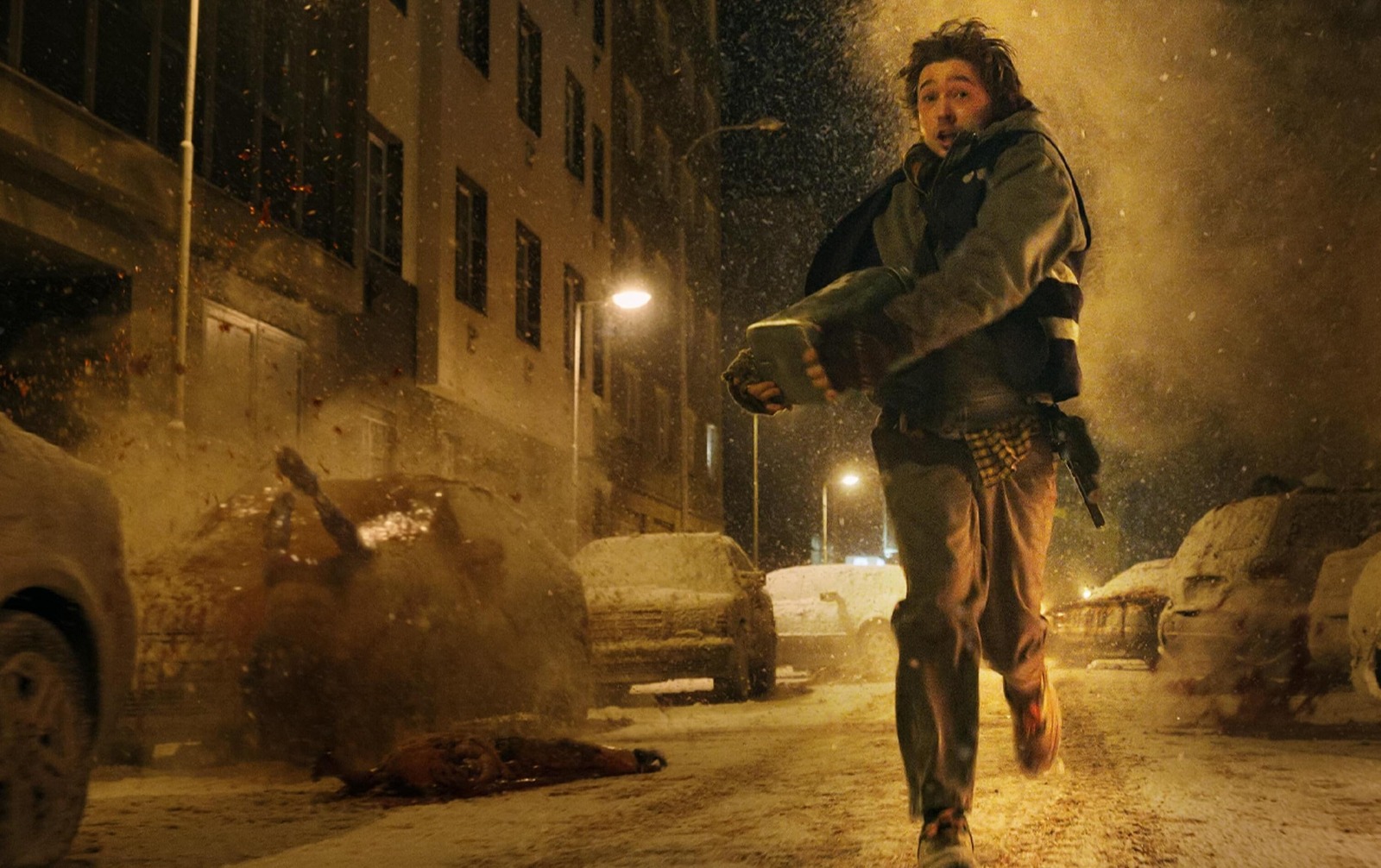
Don’t trust the shadows – that is the seminal feeling emanating from Zach Cregger’s Resident Evil. It’s a heightened sense of paranoia that the Weapons director inflicts here: a tunnel, a barn, an isolated wooded area, a snow-covered road, a bedroom, a rooftop, a sewer system or even a darkened door are all enemies of progress; a fear of the unknown that lies in those darkened spaces, leaving nothing but your gut instincts to navigate the sensation. You feel it with medical courier Bryan (Austin Abrams) and his reckless, snowy drive toward Raccoon City. The constant cutscene switch between what’s in front of him and his girlfriend Michelle’s phone announcement that she’s pregnant conjures Resi’s first potent jump scare, the first of many escalating nightmare-fuel reveals, when a woman unexpectedly walks into the middle of the road. It plays into the expected horror tropes, and yet what’s unexpected is how the zombie woman’s transformation into an infected becomes a bona fide slapstick comedy as Bryan seeks help. It’s not every day a zombie becomes obsessed with you as its next victim!
Cregger once again proves he’s one of the most exciting directors around. His skillset for ‘reimagining’ is nothing new, but splicing horror and comedy together certainly brings out the best in him. Maintaining that risky, tonal balance has been key to his success: Barbarian felt more like a loose ‘trial and error’ exercise in how far you can push audiences’ horror expectations with the unexpected, yet the Oscar-winning Weapons saw that formula tightly refined – a stronger grasp of its multi-layered arc that brilliantly transitions towards its sensational (and deeply comical) conclusion. But with this context in mind, it’s funny to watch the internet outrage machine trip over itself on Cregger’s vision for the popular video game franchise. The lack of trust, fear and predictable ‘culture war’ positioning want us to believe that deviating from mythos and lore is a violation by someone who doesn’t “get it”. Yet, Cregger’s rebooted attempt – the eighth in the franchise – is much more than just another zombie movie with a ‘Resident Evil’ label slapped on it. It’s more audacious than his previous works, perhaps crazier given the franchise’s own bonkers reputation. 2026’s adaptation doesn’t have a ‘punching boulder’ mode or an RPG mission-ender to gleefully tap into, but it certainly has its heart in the right place.
Cregger’s deep affection for the games are on full display here, but his interests extend far beyond just faithfully retelling the franchise’s wild and convoluted history. His survival horror take is deliberately minimalistic, particularly in its use of lighting and staging to build atmosphere. It conveys the feeling of playing a Resident Evil game: that ‘locked in’ third-person camera perspective that gives you a full view of your eerie surroundings. A phone camera light that illuminates but never goes far enough to cover all the scary areas needed to see. The occasional whip of first-person shooter mode at decisive kill moments and the heightened shadows that instantly make you say “nope” while exploring. For a story mission where Bryan has to deliver an important life-or-death medical package to Raccoon City General during an emerging t-Virus outbreak, he is about to have the worst day of his life, and you will be unable to take your eyes off the screen.

Such energy bears a similar resonance to Genki Kawamura’s Exit 8, not just for its mutual understanding of how game design and mechanics work (combining technical craft with immersive production detail to amplify the purgatory states of their leading protagonists), but also for how their chief storyline centres around impending change and fatherhood. These are indecisive characters struggling with the mental gymnastics of whether they’re “ready”, and in running that gaming gamut, they either choose to accept their fate or fight to escape the madness.
Impressively, like Exit 8, Resi’s success comes down to the shared belief that video game adaptations can be more than just ‘ticking all the boxes’ for quick, easy IP dopamine hits when it comes to in-game lore, jokes or cameos (looking at you, Illumination’s Super Mario Galaxy Movie). It can be something deeper and richer, not beholden to gaming conventions whilst unlocking something bold and refreshingly new. And in having something meaningful to say, that formula, which Cregger embraces with open arms, not only feels like the best way to approach the medium, especially with Hollywood’s protracted past of unsatisfactory adaptations, but it already puts Resident Evil head and shoulders above its cinematic predecessors in the franchise.
If you’ve never watched or played a Resident Evil game in your life, the script co-written by Shay Hatten doesn’t punish you for not doing your homework. It cleverly treats Resi’s original storyline like a DLC, an extended, complementary adventure within Capcom’s universe and follows our hapless gig-economy NPC through the trials and tribulations of the outbreak. Its ‘pick up and go’ adventure delivers on the thrills as our hero goes from A to B, finding himself in impossible situations to survive the night. And survive he does, through sheer naivety, incompetence, disbelief and ignorance as the prolonged scares ‘stir up the crazy’ towards its boss-level third act.
The comedy element may ‘make or break’ the experience, but its compellingness comes from Bryan’s lack of survival skills, a character recipe far removed from the trained heroics of Jill Valentine, Leon S. Kennedy or Chris Redfield. It takes pleasure in that everyman approach, and at every turn where choices are made, he is a walking, talking disaster. Abrams’ stellar performance perfectly crystallises every bit of Bryan’s traumatic helplessness and relatability before veering towards those comedic bouts of levity. Escaping a zombie dog by climbing a ladder and later discarding it, for example, becomes his own downfall when he later needs it to escape to the other side of the building. But it also takes note of how he manages to “level up”, going from nothing to a pistol, shotgun, and machine gun that feels like just rewards for someone who grows within a structured gaming narrative.
And in a world where everything is out to get you, including all mutant shapes, sizes, eyeballs, tentacles and cartwheeling body contortions, Resi delightfully invites audiences to play the game, envisioning you as the worst player imaginable. As you grip that controller, Cregger and Hatten’s whip-smart script speed-runs through puzzles and scene exploration (including typewriter save points) with equal measure of tension and blood-soaked payoffs before pivoting to a larger commentary on gaming culture itself: a hotshot you might be in the gaming world with your accumulated fighting combos, power-ups, and weapons, but the real-world physics of shooting a padlock from distance will be your sworn enemy as you feel fear breathing down your neck. But no matter how disgustingly freaky or gnarly those biohazard monstrosities are (and there are plenty to unsee), it’s the commitment to the absurdity that ultimately wins.
Resi’s kitchen-sink mentality does threaten to undermine its cohesiveness in the film’s third act (alongside some undeveloped character work in the latter half), but it’s the sheer fun that keeps that momentum going. Cregger knows exactly how to get the best out of the horror/comedy material without veering over the edge, relishing the pulsating linear momentum that always refuses to turn back and accepts whatever demented carnage awaits. It entertains in the best possible way, a confident level-up that stands out as the best in the franchise, and by getting the fundamentals right, Cregger’s Resident Evil serves up a glorious horror treat.







-

 News3 weeks ago
Full 2026 Programme Announced For BFI London Film Festival
-

 Featured Review2 weeks ago
Venice Film Festival 2026 – Primetime ★★★★
-

 Featured Review3 weeks ago
The Incomer ★★★★
-

 Featured Review4 weeks ago
The Dog Stars ★★★★★
-

 Featured Review3 weeks ago
Late Fame ★★★★
-

 News3 weeks ago
Full Programme Announced For 20th Anniversary Edition Of Iris Prize
-

 Featured Review3 weeks ago
I Want Your Sex ★★★★★
-

 Featured Review3 weeks ago
Venice Film Festival 2026 – Bucking Fastard ★★★