

Featured Review
Sundance 2026 – Everybody To Kenmure Street ★★★★

Released: 13 March 2026
Director: Felipe Bustos Sierra
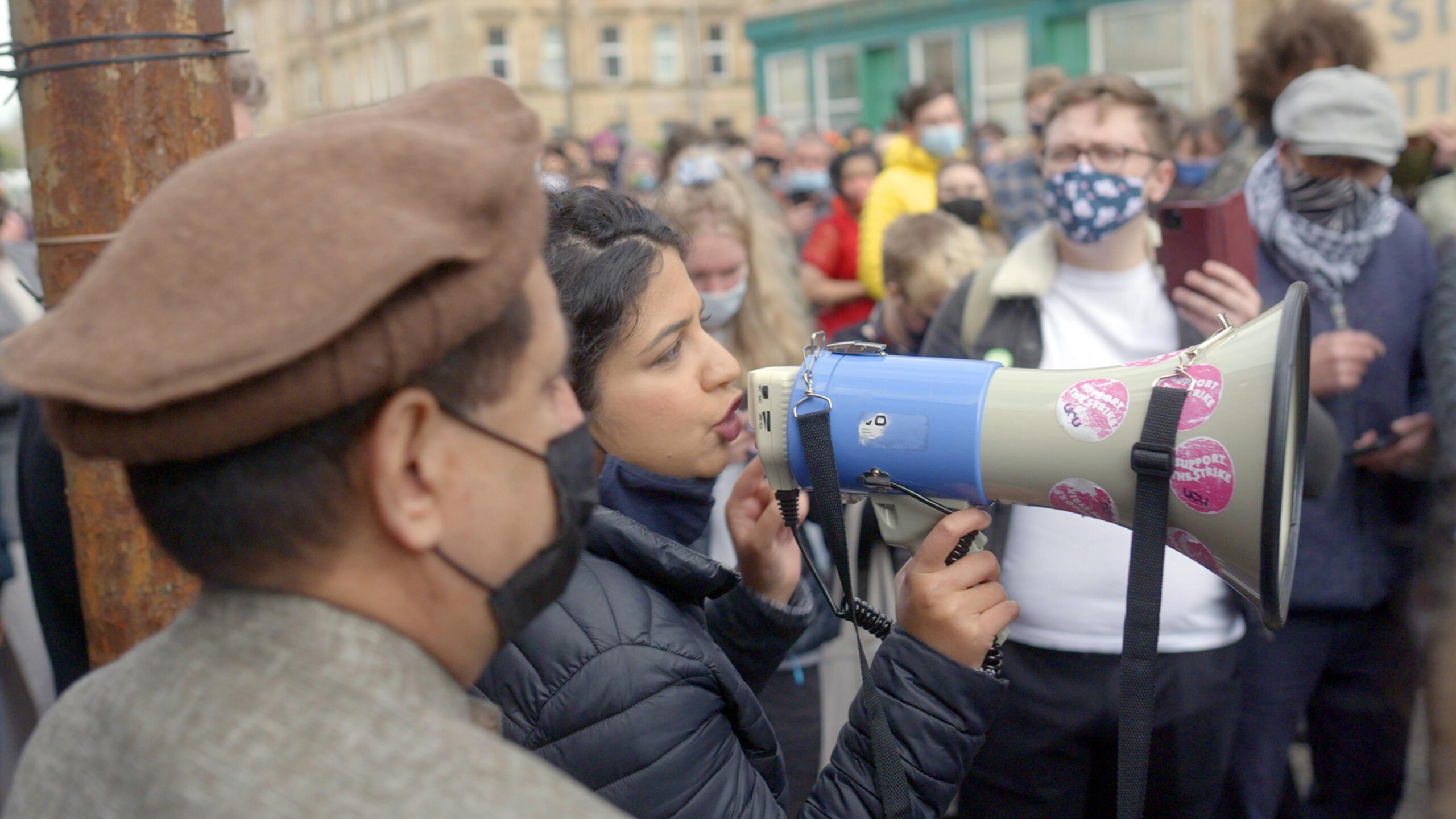
Taking us back to 2021, at a moment when the world was watching and was in the midst of another Covid 19 lockdown, Everybody to Kenmure Street explores a powerful moment of protest. The residents of renowned Glaswegian street, Kenmure Street, protested to protect their community from being disrupted during an Eid dawn raid.
The film takes a moment to place its viewers into the historical context of the incident and Glasgow’s relationship with societal change and racial tensions. There is archived footage that flashes on the screen firmly making viewers aware of Glasgow’s past experience with protests and anti-authority movements during the industrial revolution and suffragettes movement. But, there is the deliberate, directorial choice to emphasise Glasgow’s limited involvement within the trans-Atlantic slave trade despite having landowners with enslaved persons who built Kenmure House on Kenmure Street. Silent but effective, this montage cements Glasgow’s reputation as a tough but injustice fighting community. The passage of time within the montage also demonstrates the increase in immigration with mixed communities appearing from varying countries. Footage of a Margaret Thatcher speech and the visit by Nelson Mandela to Glasgow’s streets, with an unveiling of a change of street name to bear his name, to the chagrin of commentators with extreme political views, also firmly highlight the political stance.
The community’s need to oppose the status quo is just as apparent during the summer of 2020 during the intensity of the first lockdown for covid 19. Tensions were inflamed during the brutal incident involving George Floyd as community members joined together in protest. All of this background sets the tone for an orchestrated community wide act of resistance when injustice rears its head against the residents of Kenmure Street.

On 13 May 2021, the residents of Kenmure Street in Pollokshields, Glasgow, were awakened by mobile phone notifications alerting of a dawn raid taking place. The incident impacted their neighbours but it was during a moment in history where we had all been deprived of socialising together, with people on furlough, and therefore there was more intense focus on social media such as Twitter, now known as X, and the 24 hour rolling news headlines as sources of information and entertainment. As such, one woman named Tab decided not to ignore the text messages and to become involved as one of the first on the scene. As there was so much intense, global observation of events on social media, she had wisely decided to record events with such footage forming a large segment of this film.
The film mainly focuses on this unprecedented, spontaneous occurrence of a Home Office Immigration van parked in the middle of Kenmure Street to deport two individuals believed to be residing illegally. Through a series of talking head interviews, interspersed with actual footage of the incident, director Felipe Bustos Sierra reveals the impact of such an event on a community. This was not a stealth attack, as anticipated by the authorities, given its timing to occur on Eid. Instead, this demonstrated a community mobilised to assist their friends. It is via the actions of one courageous neighbour, who effectively halted the van in its tracks, that prevented the detainment of these individuals. Whilst the film does not focus on the perspective of the individuals retained within the van, the sentiments of the neighbours and others drafted in to the community to assist provide the film’s beating heart. Highly emotional and compelling as the day progresses, the film ratchets up the feelings of hopelessness and despair as more people from the community leave their jobs early or contact others to assist in this demonstration against authority.
Everybody to Kenmure Street illustrates the power of one person and a small community to make a difference. Were it not for one man’s actions who pushed aside concerns of his own safety, to lie underneath the van, there may not have been leverage to instil change on that day. The film highlights all of these perspectives via wide angle pans of the increased numbers of people joining the crowd but does not hesitate to personalise its scenes by zooming in on the individuals joining forces to broker a resolution peacefully. Where Everybody to Kenmure Street steps outside of the tried and tested documentary narrative is by employing a docu fiction device to utilise renowned actors, such as Emma Thompson, to portray various characters within the day’s events but re-iterates their own words. As such, the film is also giving a voice to those that remained invisible.
In addition to providing an authentic account of the day and the community’s need for peaceful protest, the film underlines, through excerpts of speeches and other soundbites, the disconnect between Police Scotland and Westminster. The testimonies of the witnesses, including the Human Rights lawyer Aamer Anwar, indicated that the dawn raid occurred at the behest of the Home Office however, whilst Scottish First Minister Nicola Sturgeon was attempting to contact Westminster, their phones remained unanswered. The film excels in building up such moments of tension alongside the pressure of the crowd control versus the police making arrests. Chants from the crowd such as ‘No borders, no nations – stop deportations’ highlighted the urgency, at that period, to reverse many anti-immigration policies that the Conservative Party had enacted as Priti Patel is mentioned to have been the architect as Home Secretary.
Additionally, there is that sense of déjà vu as the Glasgow Girls also make an appearance, after their successful campaigns in 2005 to prevent the unlawful detention of minors targeted for deportation. It feels as though history is repeating itself and memories were short by attempting deportations, once more, within a diverse community prepared to resist.
Captivating from start to finish, this is a snapshot of history and the power of protest, between covid lockdowns, when the world stood still. This is a touching example to us all, that indeed one person can make a difference and that we are all stronger together in unity as part of strong communities like Kenmure Street. Unfortunately, given the recent dramatic changes to some of the social media platforms, the Twitter accounts mentioned as being integral in notifying people of the dawn raid on Kenmure Street, such as the No Evictions Network and Anti Raids Network are no longer active but films such as this will undoubtedly remain to be powerful evidence in the ongoing fights against injustice.










-

 Featured Review3 weeks ago
Iron Lung ★★★
-

 News4 days ago
Full 2026 Programme For BFI Flare Revealed
-

 Featured Review4 weeks ago
Return To Silent Hill ★★★★
-

 Featured Review4 weeks ago
Scarlet ★★
-

 Interviews3 weeks ago
Interview With Director Renny Harlin (The Strangers: Chapter 3)
-

 Featured Review2 weeks ago
Twinless ★★★★★
-

 Interviews2 weeks ago
Up Close with Marc Cubelli
-

 Movie Reviews2 weeks ago
The Day The Earth Blew Up: A Looney Tunes Movie ★★★