
Features
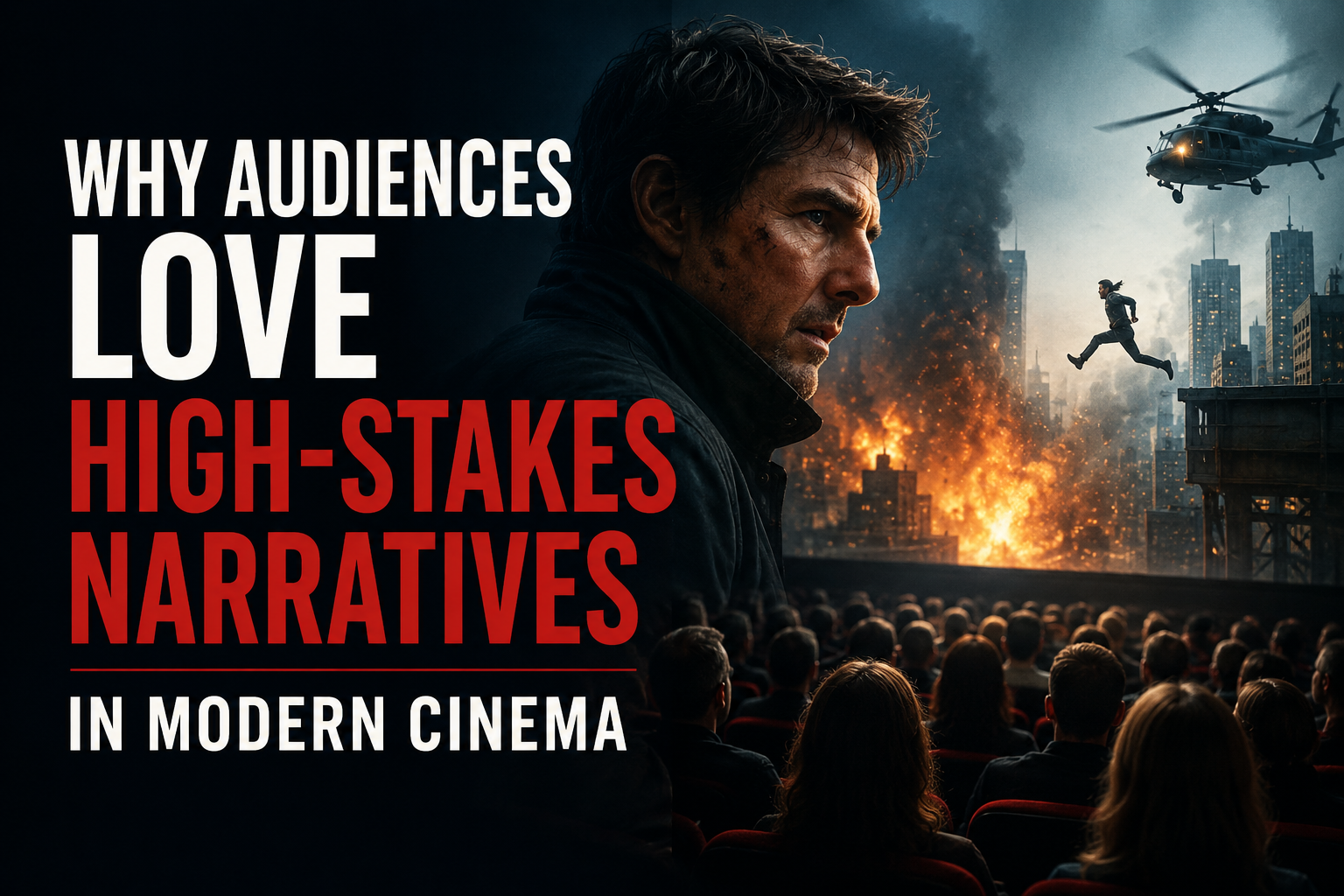
Why Audiences Love High-Stakes Narratives in Modern Cinema

“Dune”, “Squid Game,” “The Substance” – these films have earned ten times more than their production budgets. Why do we love these stories so much? The secret is that one way or another, the main characters put everything on the line: mankind’s fate, their own lives, or their sense of identity. It always gets under the viewer’s skin, creating a sense of maximum immersion and empathy. In this post, we discuss why people adore different types of high-stakes events in modern cinema (with examples).
Why High-Stakes Narratives Make Viewers Care
Scenarios with high-stakes events suggest movies in which a character’s mistake is irreversible. This refers to everything the person or a group of people stands to lose: reputation, relationships, life or soul. Sometimes the stakes skyrocket to the point where the whole human race or galaxy is on the line.
The viewer cannot put down such stories because of the existential, physical and emotional risks that characters face throughout the narrative. You immediately feel empathy for the hero(ies) and adrenaline that drives survival instincts, as if it were you there. Dopamine comes from curiosity and anticipation of a resolution. What’s on the screen mirrors the real world, serving as a safe simulation for the brain. That hooks us in an instant, keeps us glued and makes us care about the character(ies) and what happens to them.
Now, let’s discuss the four main scenarios with a high-stakes narrative and examples.
Global Stakes: When Humankind is On the Line
Existential stakes press down with their sheer magnitude, unleashing a primal fear of massive catastrophe.
Dune: Part Two (2024)
In Denis Villeneuve’s “Dune: Part Two,” global stakes escalate to extreme levels. Paul Atreides (Timothée Chalamet) carries an immense burden of responsibility for his decisions – those that, in turn, trigger waves of inner conflict and transformation. One mistake and intergalactic war begins. How can we estimate the depth of viewer investment? Well, the film grossed over $700 million at the box office and earned a 94% rating on Rotten Tomatoes. Figures speak for themselves.
Oppenheimer (2023)
Christopher Nolan’s historical blockbuster “Oppenheimer,” starring Cillian Murphy, is an outstanding example of how the fate of civilisation can depend on a small group of people. From a scientific standpoint, the chance of igniting the atmosphere is close to zero, but in the film, this slim chance becomes a massive psychological weight for the viewer. The story about creating a weapon capable of destroying the Earth earned $975 million at the box office and secured its success with seven Academy Awards. Cillian himself is an intense performer, so talented he is.
Survival Stakes: Make It Out Alive or You Die

Even when it comes down to the survival of just one person or a small group, danger reaches out and touches the skin with cold fingers. This theme is among the most popular on streaming platforms such as Netflix, HBO Max, and Apple TV+.
Squid Game: Season 2 (2024, Netflix)
Hwang Dong-hyuk returned to the screen to continue the story with binary stakes: life or death. Uncertainty becomes the primary motivator of audience participation as each outcome is unpredictable. The risk is absolute, so our brain is locked in a permanent state of intense emotional arousal. This appeals to the audience: Squid Game received 68 million views in just four days after its release.
Society of the Snow (2023)
Juan Antonio Bayona’s film, Society of the Snow, is based on a real event – the Andes plane crash. The fact that all of this actually happened makes it even more disturbing. The characters have no classic antagonist, they aren’t playing for money or power. Instead, they must fight cold, hunger, freezing temperatures and countless dangers to stay alive. You cannot intervene, and this creates the dopamine loop.
Where’s the limit of human endurance? Everyone has their own boundaries, but only the hardiest species can survive.
Criminal Risk as a Life Strategy
In criminal flicks, every scene is risky; every step can turn everything upside down. People play for real money, either directly at the table or chase wealth in other ways.
Mission: Impossible (2023)
Christopher McQuarrie plunges the viewer into the frantic behind-the-scenes world of global security systems. While Ethan Hunt (Tom Cruise) takes part in a heist or breaks into a system, audiences forget even how to breathe. What’s more, a dynamic plot twist midway through the film completely changes the rules of the game.
The Card Counter (2021)
Director Paul Schrader showed how a former military interrogator, William Tell (Oscar Isaac), plays not so much cards as fate itself. William drifts easily from one casino to the next, but when what’s at stake is not money but the life of a young man named Cirk (Tye Sheridan), the tension escalates to extraordinary heights. In the real world, the person does not have to retreat to a safer distance to remain unnoticed like the movie’s hero. Top online poker sites offer an environment where anonymity and security allow us to experience true excitement without even leaving our homes.
Personal Stakes: When the Hero Destroys Themselves
Personal stakes feel the most painful. The threat of losing oneself seems even scarier than an apocalypse – because it hits close to home for everyone. Directors know what it’s like when the loss of one’s own identity hangs like a sword of Damocles. And they know how to make the audience feel that fear alongside the main character.
The Substance (2024)
Coralie Fargeat uses hyperbole to illuminate how easy it is in the modern world to suffer a personal collapse – even simply because you no longer meet impossibly high standards. Elizabeth Sparkle (Demi Moore), in pursuit of reclaiming her conventional attractiveness, risks everything and agrees to an experimental – and truly terrifying – procedure. She keeps going until she loses herself. The plot twist in “The Substance” is so close to today’s realities that the main character’s tragedy is felt in every cell of the body.
The Menu (2022)
Director Mark Mylod managed to release a true culinary thriller. However, at the forefront of “The Menu” film are not the dishes of Chef Slowik (Ralph Fiennes). What we see on the screen for nearly two hours is the tragedy of human honesty. Margot (Anya Taylor-Joy) is the only one who opts to be genuine and true to herself until the end. It never even occurs to the others to do the same, and they pay a terrible price for it.
Conclusion
As long as flick characters have something to lose, we are deep in the narrative. Every second of such films keeps us in suspense right through to the final credits. The balancing act between life and death, the adrenaline rush of the climax – these are what forge an unforgettable cinematic experience. That is why movies like “Oppenheimer”, “Interstellar” and “Society of the Snow” are the most discussed, analysed, and rewatched.


-

 Featured Review4 days ago
Digger ★★
-

 News4 days ago
Shane Meadows Headlines + Joe Lycett Named First Patron As 2026 Forward Film + TV Festival Opens In Birmingham
-

 Featured Review4 weeks ago
Venice Film Festival 2026 – Primetime ★★★★
-

 News1 week ago
70th BFI London Film Festival Announces ‘LFF For Free’ Programme
-

 Featured Review2 weeks ago
Resident Evil ★★★★
-

 Featured Review4 weeks ago
Venice Film Festival 2026 – Wild Horse Nine ★★★★
-

 Featured Review2 weeks ago
Sense And Sensibility ★★★★
-

 Featured Review3 weeks ago
Oasis: Don’t Look Back In Anger ★★★★