

Movie Reviews
Glasgow Film Festival 2026 – The Plague ★★★★

Released: TBC (Glasgow Film Festival)
Director: Charlie Polinger
Starring: Everett Blunck, Kayo Martin, Joel Edgerton
Childhood often reminds us of a life that was so carefree, but Charlie Polinger’s directorial debut, The Plague, is a stark wake-up call of how hard growing up can be. I was born in 1995, around the same time this film is set, and it felt 100% real to me. The clothes, the music, the awkward early-2000’s vibe all strike true. Seeing it, I kept thinking about kids in my school who wronged others just for being different and the social hierarchies that were rarely questioned. On the surface, it reads as a familiar coming-of-age narrative: a boy moves to a new city, desperately wants to fit in, and quickly learns that peer groups can be cruel. Polinger slowly transforms this familiar setup into something tense and disquieting through the use of body horror and tension building. Even ordinary moments like sitting in the cafeteria, mispronunciation, or polo practice in the pool can all decide your social standing. The highest importance is the status quo and need for acceptance.
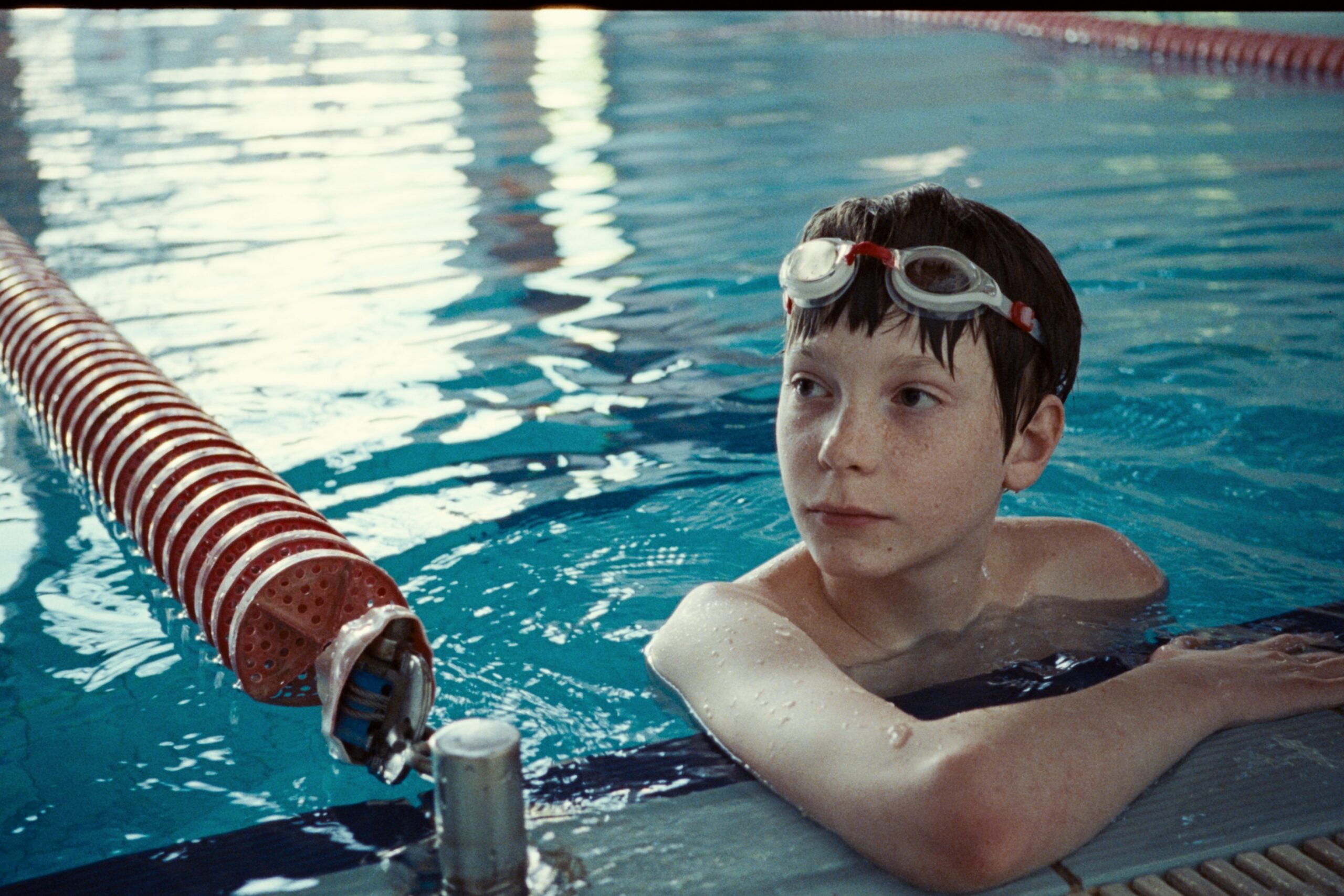
At the heart of the film is Ben (Everett Blunck), a perceptive twelve-year old trying to find his place. Joining the all boys team we quickly learn that Ben is different to the other boys in small but telling ways. While Ben asks tactical questions, the other boys, particularly the prankster ringleader Jake (Kayo Martin), who are more interested in drawing profanities on the whiteboard or undermining the coach who serves as the only adult presence. These early scenes serve as a jarring demonstration of Ben’s reflective attitude toward the society he’s entered and Jake’s dominance over what is acceptable and what isn’t. Jake keeps calling Ben ‘Soppy’ because he can’t pronounce the T in ‘stop,’ and the way Kyle Martin delivers that line with a smirk is haunting. This immediately sets the power dynamic of the group, and how little mistakes can define you.
Ben must also contend with the sadistic ritual that happens when they meet Eli (Kenny Rasmussen), the chubby boy the group dubs “The Plague.” Touch him and you need to shower; run from him and you’re safe. The “plague” is metaphorical as it is semi-literal. Eli has a rash on his back that is clearly just acne. But “the plague” serves also as a social contagion, and anyone seen as his friend risks being marked as a “weird” kid, exactly what Ben doesn’t need. Most of Eli’s days are spent hovering on the edge of the camp’s pecking order, studying the other boys as they prank and spout insults about things they most certainly don’t understand. Ben likes Eli but he is scared he would lose social standing if he protected him. Polinger captures his moral paralysis through behaviour rather than dialogue. Blunck portrays this pressure with such maturity for his age that is genuinely impressive through subtle pauses and shifts of posture that feels awkwardly real.
Steve Breckon establishes the discomfort through his surreal cinematography too. The boys swim in a pool, limbs rippling, heads barely over the surface. The camera hovers underwater in a way that helps you feel the disorientation the kids feel. As plot points play out, they are followed by surreal swim scenes that mirror the growing pressure within the microcosm of the camp. The most impressive comes in the final third where a metaphor for social survival and Eli’s distance is portrayed through a class photo. The image is emotionally rich, yet so simple. Leaving the scenes up to interpretation, The Plague succeeds in its depth through visual storytelling. This is contrasted with deep shadows, the blues of the pool glisten and the underwater angles are soft, emphasising vulnerability. Paired with the pulsing, vocal-sample-heavy score of Johan Lenox’s the tension is palpable. Music ratchets up the tension, creating a persistent sense of malaise, which never comes off loud or over the top. Little touches add an unsettling texture. Although not always presented as a horror, there are definitely nods to the classics. Jake rides a skateboard down the hallways in that scene, instantly making me think of Danny’s tricycle journey in The Shining. It’s an almost playful thing to do, though it has quiet menace about it, an assertive dominance that signifies he rules the corridors.
Pressure accumulates as the story unfolds. Ben, leaning warmer to Eli after instances of belittling him for popularity, offers to spread ointment on his rash (“The Plague”). Ben knows that this isn’t really a threat as he discusses with Eli that it’s just a cruel way to isolate him. Yet he’s seen by Jake who instantly declares Ben as now having the plague. As he is exiled, Ben breaks out in rashes and dry skin. His fear becoming physical, and the “plague” manifesting itself in a way that can be unsettling to behold. You would like to take a look away at times (itching broken skin, picking at scabs). In doing this, the film demonstrates how bullying and exclusion can make real impressions on a child, making them question themselves and their beliefs. Ben is confident that “the plague” is just a silly way to pick on Eli, however the doubt definitely sets in following Jake’s condemnation of Ben also contracting it.
The young actors are wonderful. Their chemistry and roles within their group feels scarily familiar. Each look, interaction, and nervous laugh comes off as something you can easily recognise. Similar to Lord Of The Flies, the kids are allowed to dictate how days play out with no risk. Without adult supervision, we see just how mean-spirited the group can be. The only real adult presence is seen through Joel Edgerton, the camp coach who the other kids name “Daddy Wags”. Although he can act steady and powerful, he’s never too dominant over the kids, with Jake finding ways to bypass his authority. Kayo Martin’s Jake is charming yet menacing in every way. He is a natural stand in for nascent masculinity, preying on the frailty of others with zero resistance. It is easy to understand how social groups spread influence and cruelty when you watch him.
The Plague is exceptional in its mix of the real and the tense. It’s not a very traditional horror but the use of cinematography and the score definitely present it as one. Similar to Shiva Baby, the tension does a lot of the work to induce anxiety. The fear of rejection, conformity seeking, the fear of ostracisation dictate decision making. The real horror isn’t whether the plague is there or not. It is puberty itself, and the moral compromises in the face of fear of rejection. It makes a clear point as to how easy it is for cruelty to be normalised among young boys. Polinger’s debut is so confident and assured that you may be surprised that this is his first swing. The bold yet nauseous cinematography, paired with the anxiety inducing score will absolutely stick with you. Charlie Polinger is a director that is definitely worth following closely.








-

 Featured Review4 days ago
Digger ★★
-
 News4 days ago
Shane Meadows Headlines + Joe Lycett Named First Patron As 2026 Forward Film + TV Festival Opens In Birmingham
-

 Featured Review4 weeks ago
Venice Film Festival 2026 – Primetime ★★★★
-

 News1 week ago
70th BFI London Film Festival Announces ‘LFF For Free’ Programme
-

 Featured Review2 weeks ago
Resident Evil ★★★★
-

 Featured Review4 weeks ago
Venice Film Festival 2026 – Wild Horse Nine ★★★★
-

 Featured Review2 weeks ago
Sense And Sensibility ★★★★
-

 Featured Review3 weeks ago
Oasis: Don’t Look Back In Anger ★★★★