

Featured Review
SXSW London 2026 – The Invite ★★★★

Release: 3rd July 2026
Director: Olivia Wilde
Cast: Seth Rogen, Olivia Wilde, Edward Norton & Penélope Cruz
Olivia Wilde’s The Invite opens up with an 1893 Oscar Wilde quote: “One should always be in love. That is the reason one should never marry.” It seeps through a dreamy yet radiant haze of home-style videos of Angela (Olivia Wilde) and Joe (Seth Rogen). Aside from the undoubtable essence of love and affection on display is Rogen’s infectious laughter, which is a joke within itself considering how much that iconic laugh has defined the genre.
But the quote itself acts as a punchline, a genius remark on the duelling fight between love and the trials and tribulations of co-dependency. Because soon enough, a drastic smash cut ushers us to the present. Happiness has been replaced by disinterest and disengagement as Joe, a school teacher by trade, cuts a tragic lonely figure as he sits in the school auditorium watching his pupils play their instruments. After the band finishes playing (because he can’t be asked to give them any musical critique), he grabs his bike (with small wheels he has to pedal four times to get one normal rotation), and exits stage right.
If Joe’s fortunes sounds like a musical advert for Talking Head’s Once in a Lifetime as he wonders “well, how did I get here?”, then it’s credit to Wilde’s direction. The Invite – based on the 2020 Cesc Gay film Sentimental – revels in contrasts. While Joe cycles uphill home (which might as well be a metaphor at this point), Angela shops and curates her artistic life based on an upcoming evening plan of inviting their upstairs neighbours for dinner (which she may or may not have told her husband about). It’s intentional from the get-go, a married yet emotionally and physically distant couple occupying separate worlds — all set against the backdrop of its simultaneous montage and a gorgeous amount of film grain aesthetics ripped out of a 60’s French film. It is the calm before the eventual storm, and Wilde lights the fuse for the firework display to begin.
It’s somewhat poetic for Wilde to take on this film project. Her directorial debut in Booksmart felt like a true coming-of-age moment in recontextualising the teen-comedy drama through a female lens. Her sophomore effort, Don’t Worry Darling, can be admired for its scale and ambition but was heavily undone by a predictable plot and various behind-the-scenes controversies that became more publicised than the film itself. While male directors can escape bad press like water on a duck’s back, this is an industry that doesn’t always treat female directors with similar courtesy. And that’s why it’s pleasing to see Wilde’s return after a four-year absence. The Invite is an intimate, single-location drama where comedy and tension walk hand in hand, buoyed by outstanding character performances that keeps this ticking time bomb of marital revelations going. It’s therapeutic by design, and a reminder that not only is Wilde a good actress in her own right, but she’s also one hell of a good director. This is her comeback opus.
It also feels like the right time for her return. There’s a shared synergy in the latest trend of films such as Celine Song’s Materialists and Kristoffer Borgli’s The Drama, films prepared to shed the historic layers of romanticism that Hollywood has fed us for generations with a modern-day contextualisation of evolving desires and wants. Can a relationship survive this landscape of brutal honesty and uncomfortable conversations? Well, The Invite enters the chat with its own contemporary take.
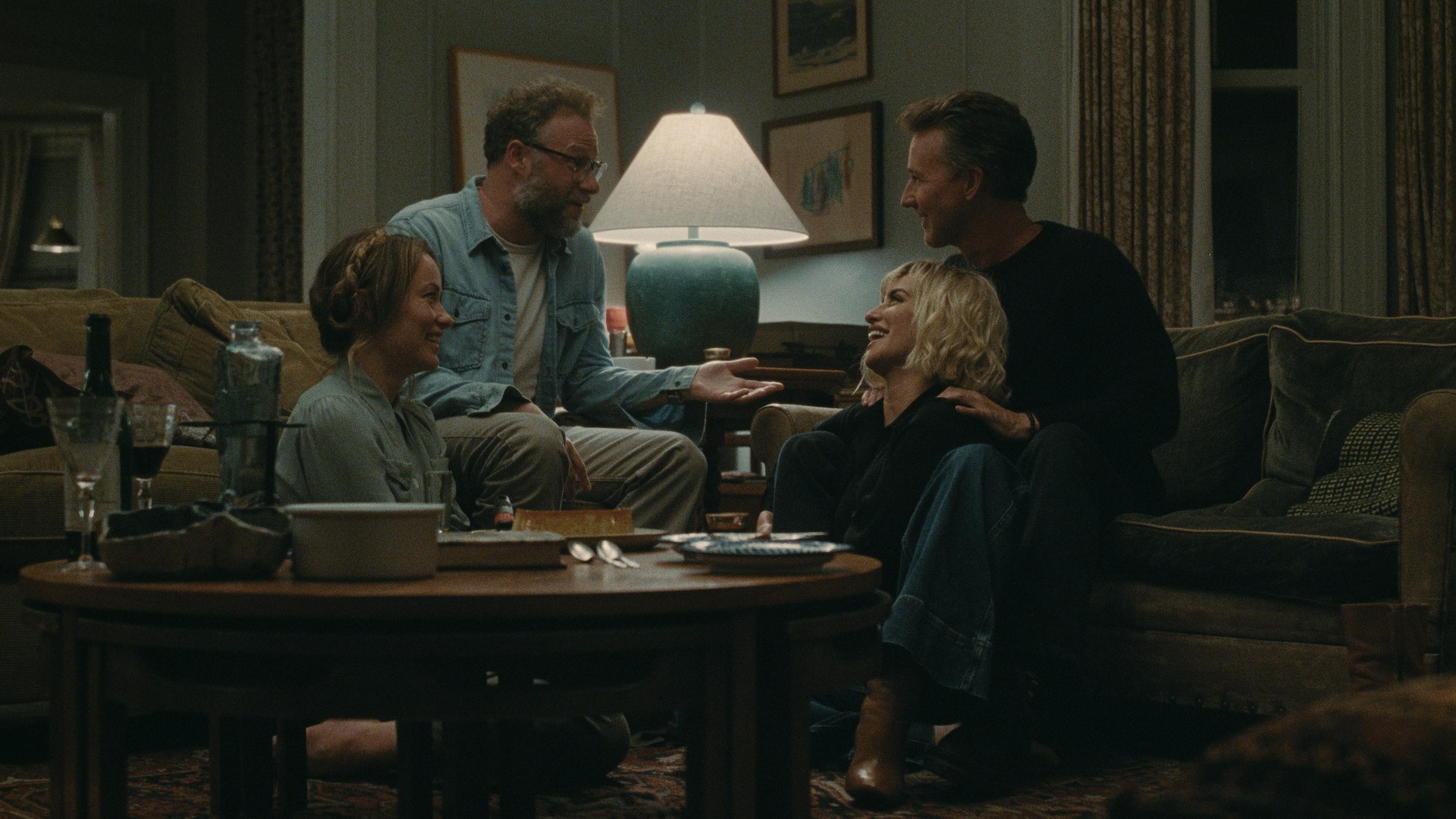
Wilde imparts the film with a key understanding: that faults are not singular, especially when it is a series of failed expectations and frustrations that eventually leads to a marriage falling apart. It plays into the awkwardness of trying to find love and be desired again, with an unconventional method used to rekindle the spark that was once lost – a sexual orgy invitation instigated by their neighbours, Hawk (Edward Norton) and Piña (Penélope Cruz).
The most impressive element is the drama before the neighbours turn up. Wilde establishes a chaotic rhythm of comedic back-and-forth arguments with Joe and Angela, bouncing off the walls that expertly plays into their disillusioned and combative personalities. Joe’s cynicism mirrors Angela’s hyperactive desire to ‘people please’, hoping to make a good impression with her expectant guests. The hilarious tension, charting anything from a new rug to an unhealthy amount of cheese and jamón, revs up a gear until about 17 minutes in and audiences are greeted with a well-timed smash cut of the title card.
In all, it’s a sharp and smartly-executed delight, a wicked, tit-for-tat masterclass in wordplay and acting with Wilde and Rogen on top form in bringing the best out of each other. It’s an old-school slapstick chemistry that on one hand feels scripted but with the artistic licence to improvise their conflicting emotions. And both are not afraid to lean into the silliness of its concept which produces some genuine laugh out loud moments. Rogen, in particular, manages to combine drama with a Looney Tunes-like facial expression to showcase his displeasure and disdain.
The humour only intensifies when Hawk and Piña finally do arrive, a free-spirited couple who look like they’ve unhooked themselves from The Matrix and are living their (supposedly) best relationship lives. They are the counter opposites of Joe and Angela. They’re having great sex, enough to draw complaints from Joe for their excessive nocturnal activities. They are seemingly on the same page either speaking Spanish or open-minded on their views on sex positive experiences. For Piña’s sake, her words cut through the double standards women face, enough to quiet Joe in explaining what would happen if men went through a perimenopause.
This is where Norton and Cruz brilliantly match the energy and comedic timing of Wilde and Rogen. Their humour bursts from the seams from the script, adding fuel to the fire that further exposes Angela’s anxieties and Joe’s insecurities. It’s hilarious watching them both dial up the awkwardness of their company, where one-liners like “pushed into anal” are delivered with such sublimity. It’s a perfectionist envy that Joe and Angela desperately crave, a feeling Wilde’s film skillfully plays with in this enclosed sandpit adventure.
And for such a madcap premise, Wilde takes advantage of the unexpected turns The Invite takes. Her visual composition throughout is a joy to watch. “Stagey” may enter the brain for a nanosecond because of its theatre-like environment, but she makes notable effort to make its one-location setting feel expansive and fluid. The camera operates on its own playful rhythm. In one scene, tracking shots break up the visual monotony of cuts and reverse cuts as Angela and Joe move to have a private conversation. Occasionally, the camera moves inward, positioned closer as if it’s trying to find intimacy between its characters only to find a boundless amount of chaos that awaits. And when the tonal intensity shifts into calmer waters where Joe and Angela contemplate their neighbour’s offer, that’s when, for a brief moment, everyone is singing from the same hymn sheet.
But the beauty of Will McCormack and Rashida Jones’s screenplay is the fundamental acknowledgement that it can’t solely rely on the comedy itself. Sure, the energy is always delivered with such rapid, high-speed intensity like an epic tennis match on show. Joe’s pratfall at his attempt of seduction or Angela’s searing one-liner after she’s kissed by Piña are brilliant attempts at breaking down the absurdist barriers these characters revelled in. Yet there is a willingness to dig deeper beyond the superficial, because at some point, when the laughter ends and reality sets in, what surprisingly emerges is compassion and empathy.
It’s at this point where Wilde shines best in these complicated waters of home truths and revealed secrets, putting the respective couples through their paces only to be left bare and emotionally vulnerable by the request. There is a measured confidence and control in how she delivers those moments, happily subverting expectations whilst building upon the trademark humour that has been established throughout. Nobody’s perfect, and it makes for an endearing watch for when everything is put into perspective.
The Invite will undoubtedly go down as Wilde’s best work in her filmography, a feature willing to showcase her range whilst providing plenty of emotional heart along the way. It may have taken her a while to find that voice again, but she knocks this effort out of the park with one of the funniest movies of the year.








-

 Featured Review4 days ago
Digger ★★
-

 News4 days ago
Shane Meadows Headlines + Joe Lycett Named First Patron As 2026 Forward Film + TV Festival Opens In Birmingham
-

 Featured Review4 weeks ago
Venice Film Festival 2026 – Primetime ★★★★
-

 News1 week ago
70th BFI London Film Festival Announces ‘LFF For Free’ Programme
-

 Featured Review2 weeks ago
Resident Evil ★★★★
-

 Featured Review4 weeks ago
Venice Film Festival 2026 – Wild Horse Nine ★★★★
-

 Featured Review2 weeks ago
Sense And Sensibility ★★★★
-

 Featured Review3 weeks ago
Oasis: Don’t Look Back In Anger ★★★★